
Shadow of 2021 Civic Polls Looms Over BJP Ahead of Tripura Elections
The announcement of the upcoming municipal elections has brought the electoral arithmetic of 2021 back into focus, posing fresh challenges for Tripura's ruling BJP.
Agaratala::The announcement of the upcoming municipal elections has brought the electoral arithmetic of 2021 back into focus, posing fresh challenges for Tripura's ruling BJP. The results of the previous civic polls, held five years ago, appear to be an ominous reminder for the saffron camp. Despite the confidence that comes with being in power, the ruling party is aware that the political equations in the upcoming municipal and urban local body elections may not be as straightforward as before. Anti-incumbency sentiment, public dissatisfaction over civic services and the possibility of opposition votes consolidating could turn the elections into a major political test for the BJP. Against this backdrop, a clean public image is likely to emerge as the most important criterion in candidate selection, rather than merely relying on familiar faces and established political influence.
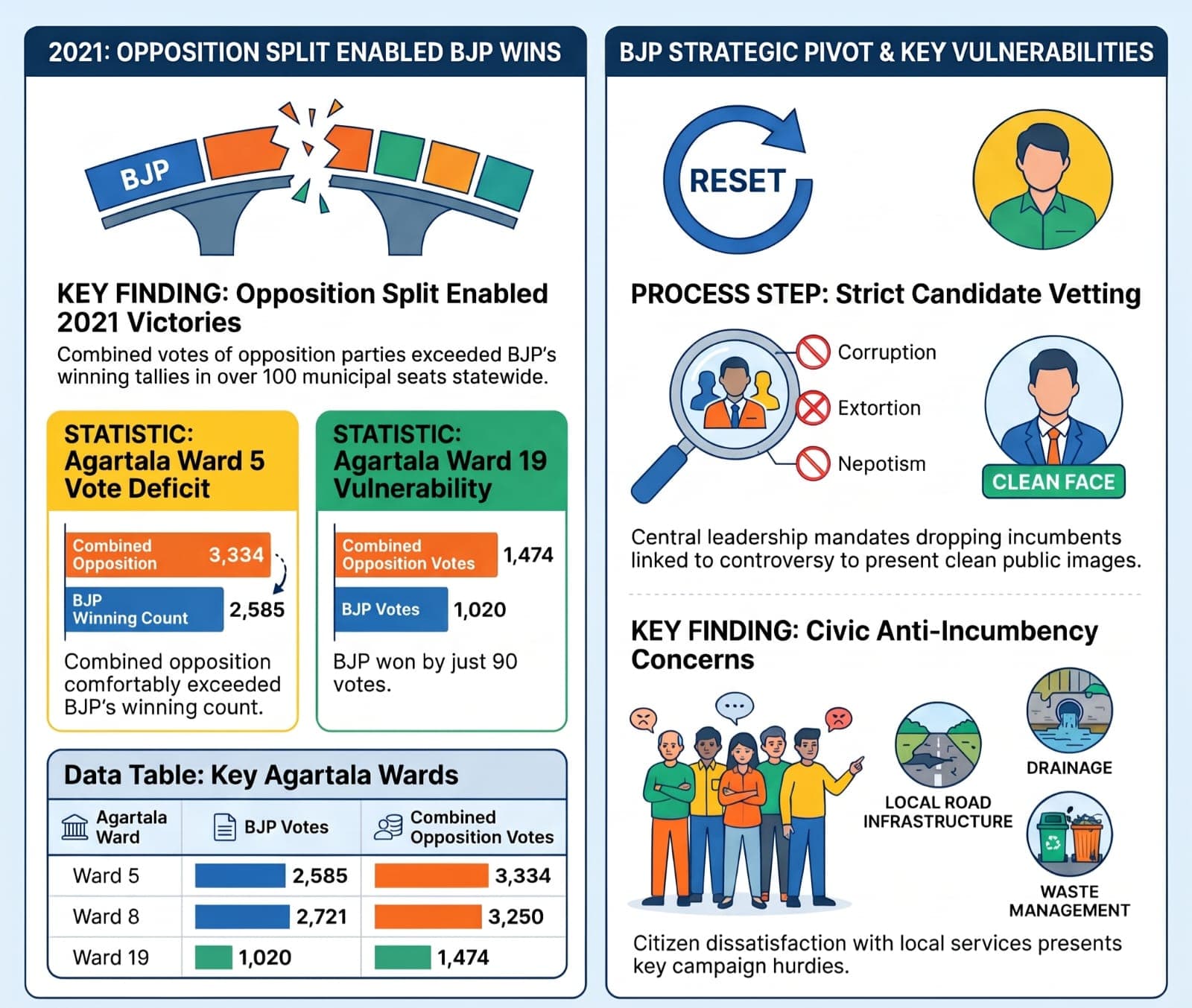
An analysis of the 2021 municipal election results offers an indication of why the BJP may be concerned. According to political calculations, the division of opposition votes had helped the BJP secure victories in several seats. In particular, had the votes secured by the CPI(M) and the Trinamool Congress been combined, the electoral outcome in at least 29 wards of the Agartala Municipal Corporation could have been different. The pattern was not limited to Agartala. Across various municipal councils and nagar panchayats in the state, the combined votes secured by the CPI(M) and the Trinamool Congress reportedly exceeded the votes polled by BJP candidates in nearly 100 seats. In other words, the BJP might have struggled to win in several areas had the opposition vote not been divided. That same electoral arithmetic is now back on the political agenda.
Although the Trinamool Congress had made a strong electoral push in Tripura in 2021, its organisational strength in the state has weakened considerably since then. Consequently, the main contest is increasingly likely to be between the BJP and the combined opposition forces of the Left and the Congress. The crucial question, however, is whether the Left Front and the Congress can reach a seat-sharing arrangement. Their recent political positions have strengthened speculation about such an understanding. If the two parties contest together, the BJP may no longer enjoy the advantage of a divided opposition vote. A direct contest between the ruling party and a single opposition candidate in several wards could make the BJP's electoral prospects more challenging.
The municipal elections in Agartala and other urban local bodies across Tripura were held in December 2021. The Agartala Municipal Corporation, 13 municipal councils and three nagar panchayats together accounted for 374 seats, of which polling was reportedly held in 222 seats during the previous election. The BJP is now determined to retain its dominance across these civic bodies. Alongside its preparations for the ADC elections, the ruling party has already stepped up its organisational activities for the municipal and urban local body polls.
One of the BJP's most significant strategies this time could be a major reshuffle of candidates. According to a reliable source within the party, the central leadership has conveyed that priority must be given to candidates with clean public images. Long-standing party workers or individuals with considerable local influence may not automatically secure nominations. The leadership is reportedly likely to adopt a strict approach towards candidates facing allegations of commission-related dealings, extortion, land brokerage or nepotism. There is also considerable discussion in political circles that the performance of several incumbent corporators of the Agartala Municipal Corporation, along with allegations levelled against them, is being reviewed. Therefore, it would not be surprising if several familiar faces are dropped in one go.
The results of several wards in the 2021 election are particularly significant for the BJP. In Ward No. 19, BJP candidate Bhaswati Debbarma won with 1,020 votes, securing victory by a narrow margin of just 90 votes. The CPI(M) received 936 votes, while the Trinamool Congress polled 538. Combined, the two opposition parties secured 1,474 votes.
In Ward No. 5, BJP candidate Lata Nath received 2,585 votes. The Trinamool Congress secured 1,562 votes and the CPI(M) 1,772, taking their combined tally to 3,334. Similarly, in another ward, the BJP secured 2,506 votes against a combined Left-Trinamool tally of 3,010. In Ward No. 8, the BJP received 2,721 votes, while the opposition parties together polled 3,250. These figures underline the potential electoral impact of opposition unity.
A similar pattern was reportedly visible in other municipal areas of the state. In Sonamura Nagar Panchayat, four wards, in Khowai Municipal Council, four wards, in Teliamura Municipal Council, four wards, and in Ambassa Municipal Council, eight of the 15 wards, the combined votes of the CPI(M) and the Trinamool Congress were reportedly higher than those secured by the BJP. This suggests that the division of opposition votes had been one of the key factors behind the ruling party's electoral advantage.
However, the challenge before the BJP this time extends beyond electoral arithmetic. Voters are also likely to assess the performance of local representatives over the past five years, the quality of civic services and the administration's response to everyday problems. Issues such as drinking water supply, drainage, roads, waste management and the resolution of civic grievances could have a significant bearing on the outcome. Allegations of corruption, nepotism, irregularities in land-related matters and preferential employment opportunities for relatives involving some elected representatives have also become subjects of political controversy. While such allegations require impartial investigation and substantiation, they could nevertheless become important campaign issues for the opposition.
During the 2021 elections, opposition parties had alleged booth capturing, attacks and widespread electoral irregularities. This time, the extent to which the elections are conducted in a free, peaceful and competitive atmosphere will also be crucial. If opposition parties are able to campaign freely, field candidates without obstruction and reach voters on an equal footing, the actual strength of the competing political forces will become clearer.
Ultimately, the electoral figures from the 2021 municipal polls are more than just a record of the past for the BJP; they serve as a political warning ahead of the upcoming contest. Anti-incumbency sentiment, dissatisfaction over civic services and the possibility of a Left-Congress understanding are together adding to the challenges facing the ruling party. The BJP may seek to address its vulnerabilities by fielding new candidates with clean public images, but whether such a strategy can change public perception remains to be seen.
One thing, however, is clear: if the opposition manages to move beyond vote-splitting and contest the elections together, repeating its 2021 performance may not be easy for the BJP. In municipal elections, it is not merely party symbols that matter. Public grievances, the performance of elected representatives and the record of the past five years are also reflected in the ballot box. The biggest question facing the BJP, therefore, is whether replacing candidates can change public sentiment—or whether the electoral arithmetic of 2021 will eventually undermine the saffron party's political stronghold.