
Jute Mill Machinery Auction at ₹3.46 Crore Raises Questions; Workers’ Future in Uncertainty
Once regarded as one of the symbols of Tripura’s industrial development, the state-owned Tripura Jute Mills Limited at Hapania is now at the centre of fresh controversy. The management has initiated steps to auction a combined lot of old but repairable production machinery, along with equipment belonging to its workshop and utility departments. The e-auction notice, carrying a reserve price of ₹3,46,44,000, has raised serious questions over the future of the jute mill.
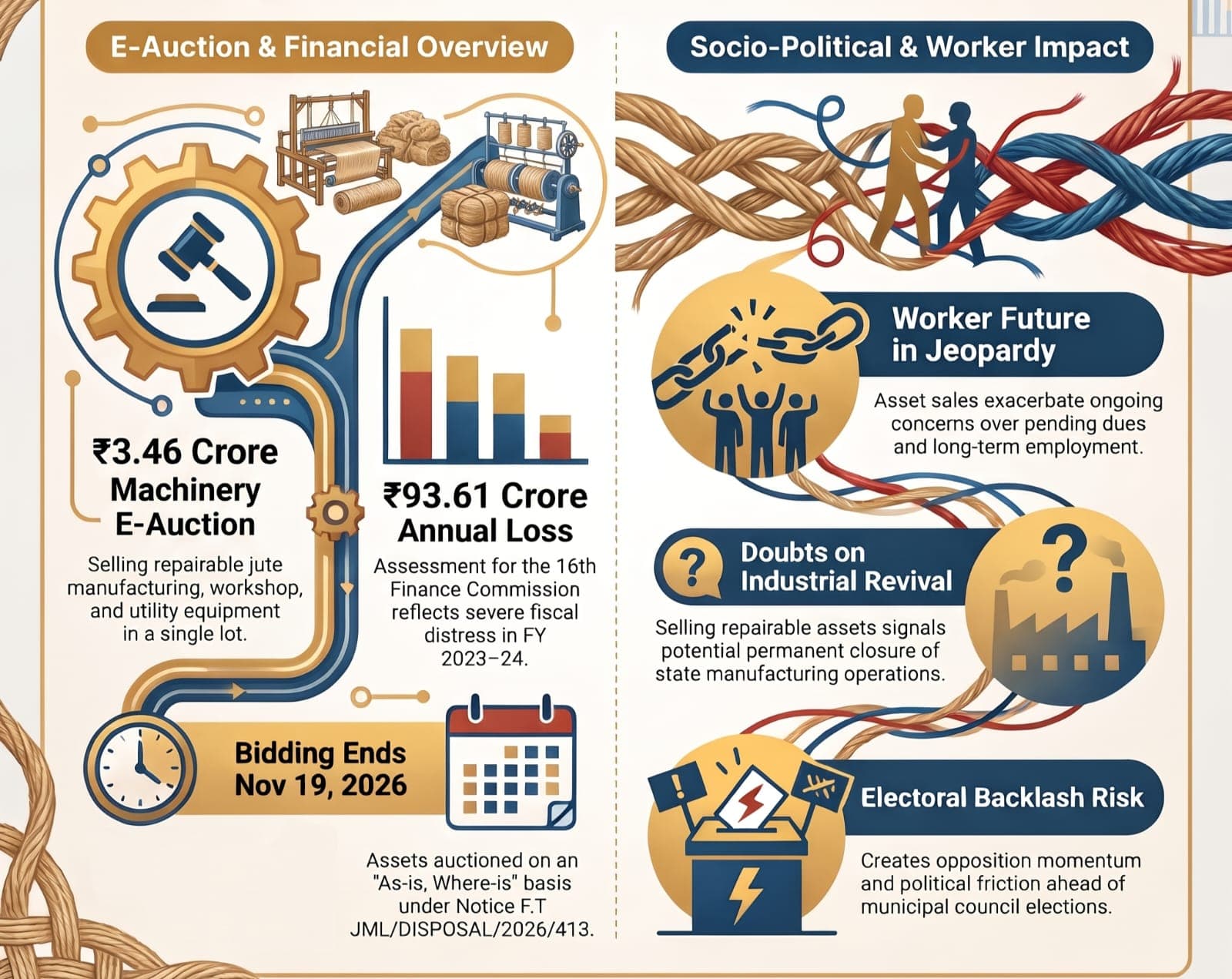
Once regarded as one of the symbols of Tripura’s industrial development, the state-owned Tripura Jute Mills Limited at Hapania is now at the centre of fresh controversy. The management has initiated steps to auction a combined lot of old but repairable production machinery, along with equipment belonging to its workshop and utility departments. The e-auction notice, carrying a reserve price of ₹3,46,44,000, has raised serious questions over the future of the jute mill. Workers fear that the gradual sale of machinery could ultimately pave the way for the complete dismantling of the mill’s production infrastructure.
Tripura Jute Mills Limited, through Notice No. F.T JML/DISPOSAL/2026/413, dated October 31, 2026, has invited bids for the e-auction. The notice has been signed by the company's Commercial Officer, R.P. Dutta. According to the notification, old but repairable plant and machinery, including equipment from the jute production, workshop and utility departments, will be sold as a single consolidated lot. The auction ID is ECA_2026_TJML_2084, with a reserve price of ₹3,46,44,000. The notice specifies October 30, 2026, as the auction date, while November 19, 2026, has been fixed as the last date for submission of bids. The assets will be sold on an 'As-is, Where-is' basis.
The most pressing question is whether the possibility of repairing the machinery and restoring production was adequately examined before deciding to sell the equipment. When the machinery itself has been described as 'repairable' in the official notice, was any assessment conducted to determine whether production could be resumed after necessary repairs? Or has disposing of the machinery become the management's priority?
Several other questions also remain unanswered. Which specific machines are being put up for auction? What is their present condition? Which agency conducted the valuation, and on what basis was the reserve price of ₹3,46,44,000 determined? More importantly, if machinery directly associated with production is sold, what scope will remain for restarting operations at the mill in the future? The BJP-led state's 'double-engine' government cannot afford to leave these questions unanswered.
With the Agartala Municipal Corporation elections, along with elections to several municipal councils and nagar panchayats across Tripura, approaching, the decision to auction the jute mill machinery could create another political challenge for the ruling BJP. On one hand, the government continues to project development and employment generation as key commitments. On the other, it is moving to auction repairable production machinery worth crores of rupees belonging to a state-owned industrial establishment. This apparent contradiction could provide fresh ammunition to the Opposition during the election campaign.
When the ruling party presents its development record before voters in Agartala, questions from jute mill workers and their families may also come to the forefront: What concrete steps has the government taken to protect the industry and safeguard employment? Alongside roads, drinking water, drainage and civic amenities, the future of the state's industrial establishments and the livelihoods of workers could emerge as another issue of political debate during the municipal elections.
The rationale behind the decision to sell the machinery, the proposed utilisation of the auction proceeds and the existence of any revival plan for the mill are issues that demand clear answers. Without transparency on these matters, the ruling BJP could find itself facing uncomfortable questions during the election campaign. After all, no matter how strongly the slogan of development is promoted, it is difficult to establish the credibility of employment promises while the future of a government-owned industrial undertaking remains uncertain.
It is worth recalling that the financial crisis of Tripura Jute Mills is not a recent development. The 50th Report of the Public Undertakings Committee of the Tripura Legislative Assembly had previously highlighted several structural problems affecting the mill, including production levels falling short of its installed capacity, inadequate availability of raw jute, a shortage of working capital and difficulties in maintaining machinery. However, despite eight years of BJP rule, no visible steps to resolve these longstanding problems have come to the attention of the people of the state.
Meanwhile, an assessment relating to Tripura prepared for the 16th Finance Commission has recorded a loss of ₹93.61 crore for the mill during the 2023-24 financial year. This indicates that the roots of the crisis run deep and have persisted for years. Yet, the crucial question remains: where is the concrete plan to bring the ailing industrial unit out of this prolonged crisis?
The biggest concern, however, is the future of the workers. The employees whose labour once kept this industrial establishment running have long been facing uncertainty over outstanding dues and other financial benefits. At a time when their pending payments and entitlements remain unresolved, the decision to auction machinery essential to production is likely to deepen their anxieties. Their apprehensions cannot simply be dismissed.
The proposed disposal of repairable production machinery, years of financial losses and outstanding workers' dues have collectively placed the mill management under mounting scrutiny. In this situation, the state government and the mill authorities must clearly explain whether there is any plan to continue production after the auction, how many workers' livelihoods will be protected and where and how the proceeds from the sale will be utilised.
The sale of machinery belonging to a government-owned industrial undertaking is not merely a commercial transaction. It involves the livelihoods of workers, the industrial future of the state and accountability in the management of public assets. The decision has therefore become a matter of serious concern for the ruling establishment.
Political observers believe that the controversial auction of repairable machinery worth several crores of rupees from the jute mill could turn into a significant political liability for the BJP in the upcoming Agartala Municipal Corporation elections, as well as elections to other municipal councils and nagar panchayats across the state. The issue could well become a test of the government's claims on industrial development, employment generation and the protection of public-sector assets.