
APL Cardholders Excluded from Free Semolina Scheme; Questions Over 65 MT and Public Funds
The Tripura Government had announced free distribution of sugar, flour and semolina among ration beneficiaries during the festive season to bring relief to ordinary households. However, the implementation of the scheme has now raised several questions, particularly over the alleged exclusion of Above Poverty Line (APL) ration cardholders from the distribution of 500 grams of free semolina. While the Food Minister had announced that all 9.92 lakh ration cardholders, irrespective of whether they belonged to the APL or Below Poverty Line (BPL) categories, would receive the benefits, the actual distribution pattern appears to tell a different story.
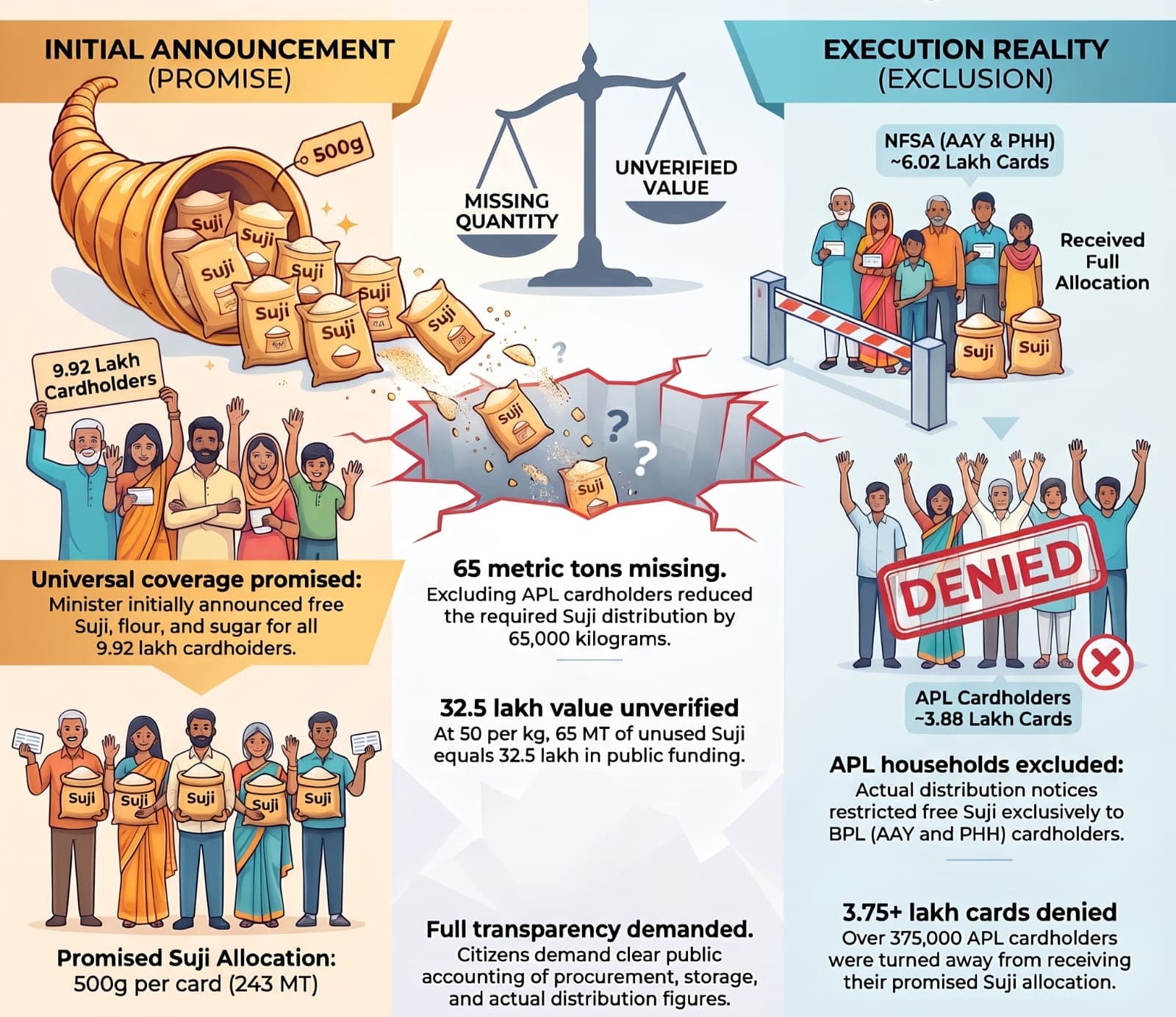
The Tripura Government had announced free distribution of sugar, flour and semolina among ration beneficiaries during the festive season to bring relief to ordinary households. However, the implementation of the scheme has now raised several questions, particularly over the alleged exclusion of Above Poverty Line (APL) ration cardholders from the distribution of 500 grams of free semolina. While the Food Minister had announced that all 9.92 lakh ration cardholders, irrespective of whether they belonged to the APL or Below Poverty Line (BPL) categories, would receive the benefits, the actual distribution pattern appears to tell a different story.
According to reports from ration shops, APL cardholders are receiving two kilograms of flour and one kilogram of sugar under the scheme, but are being denied the additional 500 grams of free semolina. Ration shop dealers have reportedly maintained that the semolina allocation is exclusively meant for BPL ration cardholders, meaning APL beneficiaries are not entitled to receive it. With the number of APL ration cardholders in the state exceeding 3.75 lakh, questions have emerged over the fate of the substantial quantity of semolina that would no longer be required for distribution. Where has the unutilised stock gone, and what is its financial value? There are growing demands for the government to make the entire account public.
On October 7, 2026, the government had announced its decision to distribute free sugar, flour and semolina among 9.92 lakh ration beneficiaries across the state on the occasion of Durga Puja. Food Minister Sushanta Chowdhury had stated that every ration cardholder would receive one kilogram of sugar, two kilograms of flour and 500 grams of semolina. The official announcement mentioned a total allocation of 243 metric tonnes of semolina, 1,984 metric tonnes of flour and 992 metric tonnes of sugar. The estimated financial burden on the state government for the scheme was projected at between ₹9.35 crore and ₹9.85 crore.
However, the actual distribution indicates that APL ration cardholders are not receiving the promised 500 grams of semolina. A report relating to the West Tripura District Administration's notification dated October 27 clearly stated that only NFSA beneficiaries under the Antyodaya Anna Yojana (AAY) and Priority Household (PHH) categories would receive 500 grams of semolina. APL cardholders were excluded from the benefit.
This raises a fundamental question: when the Food Minister announced on October 7 that every ration cardholder would receive semolina, how clearly was the subsequent decision to exclude APL beneficiaries communicated to the public? When there is such a discrepancy between the initial announcement and the subsequent distribution guidelines, is it not the government's responsibility to explain the reasons?
The state's ration distribution figures make the issue even more significant. According to Food Department data for July 2026, Tripura had a total of 9,90,771 ration cards. Meanwhile, the Central NFSA dashboard lists 1,11,359 AAY cards and 4,90,850 PHH cards, taking the combined total of these two categories to 6,02,209. This leaves a difference of 3,88,562 cards compared with the state's total ration card count.
The allegation is that excluding APL cardholders from the free semolina distribution has reduced the requirement by approximately 65 metric tonnes, equivalent to 65,000 kilograms. This raises several questions regarding the allocation, procurement cost and remaining stock of the unutilised semolina. How much money was spent on purchasing the semolina? What was the total quantity procured and brought into the state? How much was supplied to ration shops, and how much was actually distributed among beneficiaries? If any stock remains unused, in which government warehouse has it been stored?
The financial implications are also significant. At an assumed procurement price of ₹50 per kilogram, the value of 65 metric tonnes of semolina would amount to ₹32.50 lakh. At a time when the government has announced a festive relief package for ordinary people, the actual distribution must correspond with the commitments made to the public. The government must provide a detailed, fact-based explanation regarding the exclusion of APL cardholders and the difference in the quantity allocated and distributed.
Ultimately, the biggest question remains: where is the actual account of the 243 metric tonnes of semolina announced for distribution, the subsequent exclusion of APL cardholders and the alleged reduction of around 65 metric tonnes in the requirement? Does the unused semolina remain in government warehouses, has it been diverted to another purpose, or was the quantity never procured in the first place? The state administration cannot evade its responsibility to disclose the actual details of public expenditure and government-supplied food commodities.
In this situation, APL ration cardholders across the state are demanding that the Food Department publish a comprehensive account covering the category-wise number of ration cards, the total quantity of semolina procured, its actual purchase price, the quantity allocated to different categories and the amount finally distributed among beneficiaries.
After all, even a single kilogram of semolina purchased with public money falls within the people's right to know. Transparency and accountability in the utilisation of government funds and essential commodities must not be compromised.